
My neighbor was robbed twice before she eventually contacted a locksmith. And each time the thief entered her home using her front door. No smashed windows or forcible entrance. Just a weak knob lock that was easily knocked down in just one strong kick. And the fact is, such cases are quite common but often go unnoticed.
In this guide, we will discuss ways of securing your home by installing improved locks. Including standard deadbolts and advanced technologies up to insurance approved locks used all over the United States and the United Kingdom.
Why Better Locks Are the Foundation of Home Security
There are always cameras and alarms, but the actual lock is still your primary defense. There are many other devices you can attach to your doors before knowing your true weaknesses.
Where Burglars Actually Get In
It appears that about two-thirds of break-ins occur by force, with front doors being the most common point of access. In one study carried out in the UK, 58 percent of burglars used the same entrance. Rather than picking the lock, many intruders rely on brute force and kick in doors with weak frames. Poor strike plates, inadequate screws, and hallow door frames make forced entry a lot easier than most people think it should be. This trend alters the order in which improvements are made, with the door itself becoming a priority rather than just the lock mechanism.
What “Better” Really Means for a Lock
A more secure lock may not be the most expensive one available. It should be a lock resistant to drilling, picking, and prying, along with durable enough hardware to withstand a kick. According to Consumer Reports, several lock brands have been tested, and many of them including the electronic versions failed rather quickly under laboratory conditions. It highlights why independent security certifications are more important than flashy branding.
How to Improve Home Security With Better Locks on Every Door
Every exterior door deserves attention, not just the one guests use most often. Side doors, back doors, and patio doors are frequently overlooked, yet they’re just as vulnerable to a determined intruder.
Upgrading From Knob Locks to Deadbolts
Knob locks have spring latches which are usually easy to break through. Deadbolts go further into the door frame, making them more difficult to break into. For households, single cylinder deadbolts are very efficient, while double cylinder ones can protect houses against threats coming from the side of the glass window. If your door only has a knob lock, installing a deadbolt is one of the fastest and most effective ways to improve its security.
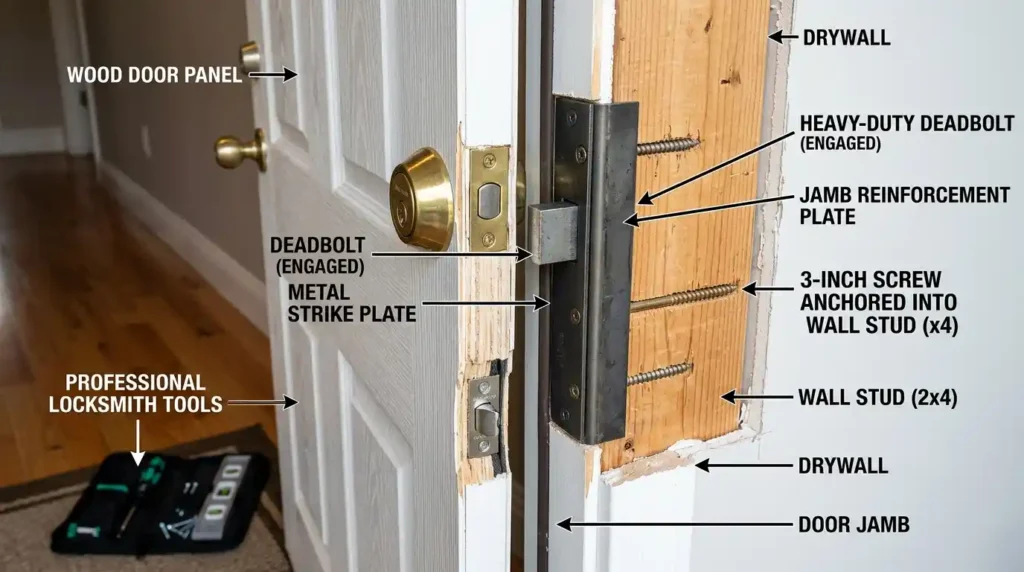
Reinforcing the Strike Plate and Door Jamb
Even the toughest deadbolt does not work when the wood around it cracks with one kick. Installing a reinforced strike plate secured with multiple long screws helps spread impact force and strengthens the door against forced entry. The replacement of three-quarter inch screws by three inch screws makes sure that the plate is fastened to the wall stud and not the door trim only. Installing a metal strip along the door jamb creates another barrier because cracking usually begins here. Such inexpensive measures can be more efficient than a costly lock with a weak frame.
Smart Locks vs Traditional Locks
While technology has impacted the way homeowners look at entering their homes by making things more convenient than mechanical locks could ever do, it is not necessarily more secure, so it is important to consider both sides of the story.
Benefits of Keyless Entry and App Control
With smart locks, you can assign specific codes to your visitors, dog walker, or any other contractor without providing them with a physical key. Some devices provide real-time alerts whenever there is an entry. You can control and lock your door with an app using Bluetooth or Wi-Fi technology, without having to turn back in case you forgot to lock your door before heading to work.
Trade-offs: Batteries, Hacking, and Reliability
Any smart lock will run on batteries, and a dead battery will normally revert you to the use of a manual key for backup. Digital systems create another type of threat: unauthorized digital access as opposed to physical breaking into the lock. Smart locks that are retrofitted, meaning they are basically traditional deadbolts with electronic capabilities, don’t make the locking mechanism stronger. Going for a credible lock brand is therefore sufficient enough to overcome these threats.
Meeting Insurance and Security Standards
A lot of homeowners do not understand that their insurance policies actually specify the locking needs of their home. Failure to adhere to these specifications could result in a claim being denied after you have been robbed.
British Standard BS3621 and TS007 Explained
Insurers in UK usually insist on BS3621 for wood doors fitted with mortice locks having the BSI Kitemark logo on their faceplate. An approved lock must have minimum five levers and 20mm bolt throw to be considered certified. In the case of uPVC or composite doors, however, the insurers usually insist on TS007 that is a star rating system, with a three-star rating representing a highly anti-snap resistant lock.
American Grading Systems and Consumer Reports Findings
In the US, ANSI grading rates residential locks from Grade 1 down to Grade 3 based on durability testing. Grade 1 locks offer commercial-level strength, while Grade 3 represents the minimum acceptable standard for homes. Consumer Reports’ evaluations of numerous models found that many still succumbed to drills or forceful kicks within minutes. That finding underlines why genuinely upgrading your locks means checking independent ratings, not marketing copy alone.
Layered Security Beyond the Lock Itself
The importance of locks cannot be overemphasized; however, it is much better to consider them as a means of security among others. This way, the use of hardware combined with increased visibility and awareness eliminates blind spots.
Cameras, Sensors, and Lighting
Motion detectors, glass break detectors, and video doorbells give additional visibility that will discourage potential burglars from attempting entry at all. Good lighting removes hiding places from your entrance, and bushes growing in front of windows usually just serve to provide a cover for an intruder. Using these technologies alongside your locks gives you better protection.
Simple Habits That Cost Nothing
Locking the doors constantly, whether you are at home or not, is something that covers up an obvious security loophole that cannot be covered up just through hardware. Taking the keys out of any hiding place and changing the locks as soon as you move into your house will get rid of any possible access that may exist before your move. This all comes with no cost but helps increase your security.
Conclusion
Securing your home does not necessarily mean that you have to replace all your locks at once. First, look at where the weak spots lie, and that would generally be the strike plate and the door frame, before deciding what type of locking device is right for your household a deadbolt or a smart lock. Going through your insurance policy for the particular specifications that your home needs will ensure your own safety and cover yourself under your policy.
Frequently Asked Questions (FAQs)
The best solution in this case would be replacing the knob locks with the deadbolt lock and adding a reinforced strike plate as a part of this process. This way one will address the main threat that many residential locks have.
Absolutely not as the smart lock is only as secure as it is mechanically and through the digital means. A reputable manufacturer with good encryption provides enough security.
In the majority of cases, you will have to provide the BS3621 locks for the wooden doors and TS007 for uPVC or composite doors on the final exit point.
It is recommended to check all your locks frequently and to rekey your locks when moving to another house or losing the keys.