
Flooring in living rooms is one of the few design elements in the house. That has more significance than any other. It is the biggest uninterrupted surface that defines the color temperature and scale and either strengthens or weakens all other decisions. That you have made with respect to the materials used around.
This complete guide will help you choose wisely and intelligently regarding floor tiles in your living room. We have covered the aspects of what materials really work. What sizes and finishes go well with what type of rooms, laying patterns and their impact on the look. And finally, the technicalities of installation by professionals.
Why Porcelain and Ceramic Dominate Living Room Tile Choices
While there have been advancements in the flooring industry in the last decade. The two materials that continue to dominate the tile flooring used in living rooms throughout the United Kingdom, United States of America, Australia, and Europe are porcelain. And ceramic tiles because of much more than just their prices. The distinction in material between porcelain and ceramic is greater than many people realize.
Unlike ceramic tiles, porcelain tiles are fired at a higher temperature. Creating a dense and non-porous surface with an absorption rate of less than 0.5%. Porcelain tiles’ density is what creates their longevity and ease of cleaning. And also makes it possible for them to be installed in heated flooring systems. Which is common in the United Kingdom and Europe today.
Vitrified, Glazed, and Through-Body Options
Fully vitrified tiles are the strongest form of porcelain. Where the glass-forming minerals are evenly distributed throughout the entire tile body. Which means that chips and scratches will not result in an exposure of the core of a different color. Double charged tiles include an extra layer of pigment added to the surface of the tiles during the manufacturing process. Resulting in a richer coloration and better resistance to wear than standard glazed tiles.
Glazed tiles have their color and design in the top layer only. In terms of use for high traffic living room floors, either fully vitrified tiles. Or through-body porcelains are superior to glazed ceramics after a span of five to ten years. PEI Rating Porcelain Enamel Institute Wear Rating scale is 0 to 5. PEI 3 is suitable for moderate residential traffic. And PEI 4 and PEI 5 are suitable for heavy residential and light commercial traffic respectively.
Polished, Matte, Lappato, and Satin Finishes Compared
Conclusion selection has the biggest impact on the tile’s performance daily compared to any other individual specification. The reflective floor tiles produce great light reflections. Making them very ideal for creating an illusion of space in small living rooms. Although the polished finishes attract footprints, dust, and water stains more easily than any other finish. Additionally, they provide a lower slip-resistance level, which is important if the household has children, elderly members, or pets.
The matte floor tiles feature good slip-resistance levels typically rated between R9 and R10. As well as providing better masking capabilities for surface wear and dirt than any other type of floor tile. The lappato floor tiles fall somewhere in between the two and offer a semi-polished finish. That has higher reflectivity than the fully matte floors without requiring too much maintenance like highly polished floors. Satin finished tiles also combine the best of the two qualities.
Floor Tiles for Living Room: Size, Format, and How They Change the Space
Large format floor tiles have dominated interior design trends since approximately 2018 and show no signs of retreating. The visual case for them is straightforward fewer grout lines produce a cleaner, more expansive floor plane that reads as calmer and more architectural than smaller tile formats. However, size selection should respond to the room’s actual dimensions rather than trend preference alone.
A 600x600mm tile suits most standard UK and Australian living rooms confidently. Moving to 600x1200mm or 800x800mm formats requires a flatter, more precisely prepared subfloor lippage, the height variation between adjacent tile edges, becomes visible more quickly on larger tiles than on smaller ones. At 1200x2400mm slab tile format, subfloor preparation, structural load assessment, and professional installation are all non-negotiable rather than recommended.
Small vs Large Format Practical Considerations
In a living room below approximately 25 square metres, a 1200x1200mm tile can feel disproportionate the format overwhelms the space rather than expanding it. A 600x600mm or 600x900mm format in the same room produces better visual proportion. Conversely, in an open plan living room above 40 square metres, a 600x600mm tile can read as busy and fragmented. The general professional guideline is that the largest tile dimension should not exceed one-third of the shortest room dimension a useful starting framework rather than an absolute rule.
Rectified tiles those cut to precise dimensions after firing, rather than relying on the kiln-fired size allow tighter grout joints of 1.5mm to 2mm. Tighter grout joints reinforce the seamless, large-format visual effect. Non-rectified tiles require wider joints of 3mm to 5mm to accommodate natural size variation something to factor into both the aesthetic outcome and the cleaning maintenance reality.
Laying Patterns and Their Visual Impact
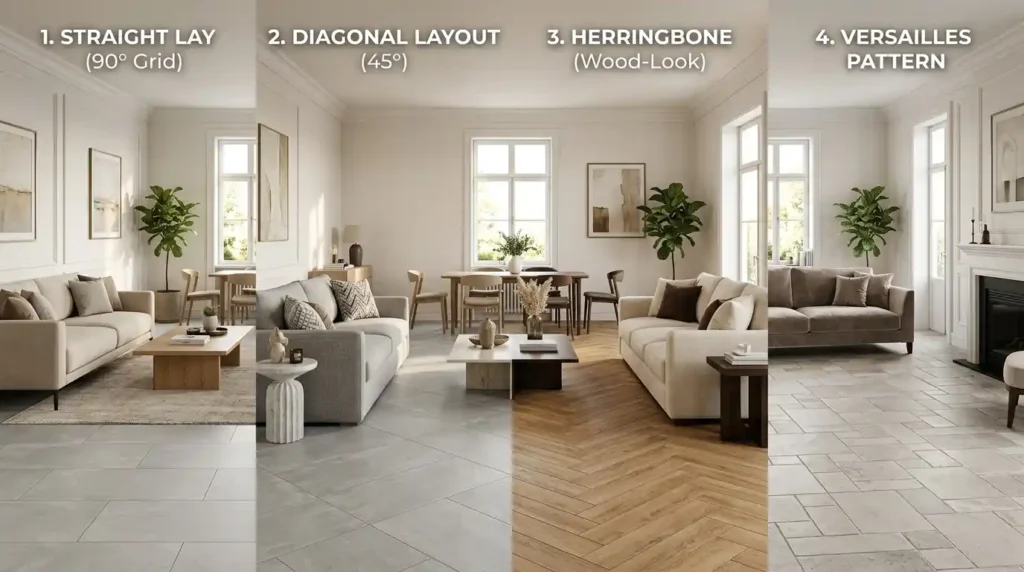
The laying pattern transforms identically specified tiles into completely different visual outcomes. A straight lay tiles aligned in a grid suits minimalist and contemporary aesthetics and wastes the least material during cutting. Diagonal tile layout rotates the grid 45 degrees, which visually expands the apparent width of narrow living rooms at the cost of additional cutting waste of approximately 15 percent.
Herringbone tiles and chevron tiles have dominated design editorial for several years running and continue to appear across Houzz, Pinterest, and Instagram tile trend content. Both patterns suit wood effect floor tiles and parquet effect tiles particularly well the directional pattern reinforces the timber reference. Brick bond or running bond tile pattern offsets each row by half a tile length, producing a classic format that suits both traditional and contemporary interiors. The versailles tile pattern uses multiple tile sizes in a repeating geometric arrangement historically appropriate for travertine floor tiles and limestone floor tiles in period-influenced living rooms.
Material Alternatives: Natural Stone, Wood Effect, and Encaustic Tiles
Aside from porcelain and ceramics, there are some other kinds of tile flooring material appropriate for living room floors that need to be realistically analyzed. There are inherent strengths and weaknesses associated with each that will have an impact on overall satisfaction.
There is something uniquely authentic and palpable about natural stone floor tiles, marble floor tiles, travertine floor tiles, limestone floor tiles, granite floor tiles, and slate floor tiles that cannot be replicated in any manufactured tile. With marble floor tiles, there is the inherent variability of the veining. With travertine floor tiles, there is the warmth of the honeyed colors that is particularly well suited for Mediterranean and transitional living room designs. The downside is the porous nature that means sealing is necessary upon installation and regularly thereafter for stain protection. Granite floor tiles are an exception.
Wood Effect Tiles and Their Legitimate Advantages
Wood look tiles have earned their popularity on genuine merit rather than marketing alone. Timber look tiles in porcelain deliver the visual warmth of hardwood flooring with the practical performance of a fully vitrified tile scratch resistance, moisture resistance, and underfloor heating compatibility that engineered wood and laminate cannot match. The best wood effect floor tiles from manufacturers including Marazzi, Atlas Concorde, Coem, and Florim produce grain detail and color variation convincing enough that the tile identity is genuinely non-obvious in completed installations.
Herringbone-format wood effect tiles in a 150x600mm or 200x1200mm size produce a parquet effect tile floor that reads as architectural and highly crafted. Ca Pietra tiles, Bert and May tiles, and Original Style tiles all produce strong wood effect tile ranges in the UK market. Porcelanosa tiles and RAK Ceramics offer accessible options at mid-range price points. For living rooms where durability, underfloor heating compatibility, and long-term maintenance ease matter more than material authenticity, wood effect porcelain tiles represent the most rational specification.
Encaustic, Terrazzo, and Zellige The Statement Floor Options
Encaustic cement tiles and zellige tiles have risen from their respective niches to become contenders for contemporary living room flooring within the last three to four years. As opposed to fired tiles that are usually vitrified, encaustic tiles are made of colored cement and need to be sealed prior to being grouted and maintained. These tiles give the luxury of colors and designs that cannot be achieved through factory-manufactured tiles. Both Bert and May tiles and Mandarin Stone tiles feature excellent range of encaustic tiles in the UK market, while Fired Earth tiles and Ca Pietra tiles provide customized options of the same.
Terrazzo floor tiles have seen an especially strong revival recently the combination of marble chips embedded in either cement or resin flooring looks both vintage and modern and suits the openness of contemporary living room flooring perfectly and wears well. Zellige tile trend sees introduction of handcrafted Moroccan ceramic tiles into the living room spaces the imperfect surface and glazing make the design rich and warm which is something that cannot be achieved by mass-produced tiles.
Installation, Subfloor Preparation, and the Details That Determine Success
The tile specification accounts for approximately half the outcome of any living room tile project. The installation quality determines the other half and it is the dimension most homeowners underinvest in. Having observed tile projects fail at the subfloor preparation stage despite perfectly specified materials, I can confirm that cutting corners here costs significantly more to remediate than the saving achieved.
Every tile installation begins with subfloor assessment. Concrete subfloor tiles installations require the screed to be dry, flat to within 3mm across a 3-metre span, and structurally sound. Timber subfloor tiles installations require additional consideration wood movement creates tile cracking risk over time, which uncoupling membrane systems including Schluter Ditra directly address by decoupling the tile layer from subfloor movement. Self-levelling compound corrects minor surface irregularities before tile laying begins.
Adhesive, Grout, and Movement Joints
Tile adhesive selection should match the tile format, substrate type, and the presence or absence of underfloor heating. Large format tiles require a flexible adhesive S1 or S2 classified products to accommodate thermal movement without bond failure. Tile levelling systems reduce lippage during installation, which matters most at 600x600mm format and above.
Grout colour changes the visual character of the finished floor significantly. White grout emphasizes the tile pattern and format. Grey grout or charcoal grout produces a more seamless, contemporary floor plane. The grout width should be specified before purchasing a tile levelling system, as the two decisions interact. Movement joints also called expansion joints must be installed at perimeter edges, at doorway thresholds, and across large floor areas at intervals specified by the adhesive and tile manufacturers. Skipping movement joints is the most common cause of tile cracking in residential installations.
Underfloor Heating Compatibility and Thermal Performance
Tiles suit underfloor heating better than almost any other residential flooring material. Their thermal conductivity the rate at which they conduct heat from the heating element to the room surface is significantly higher than carpet, laminate, or solid hardwood. Porcelain tiles conduct heat most efficiently among tile materials. The floor tile specification for underfloor heating should confirm low water absorption, dimensional stability, and adhesive compatibility with the heating system manufacturer.
Electric underfloor heating tiles installations require embedding the heating mat in adhesive or self-levelling compound, with tile installation completing over the top. Wet underfloor heating tiles installations typically cover a screed pour over the pipe array, with tiles installed directly on the screed surface. In both cases, the system must complete a full heat test cycle typically 21 days before tile installation begins on a new screed to ensure full moisture evaporation and prevent adhesion failure.
Costs, Brands, and Where to Source Living Room Floor Tiles
Understanding floor tile cost realistically before beginning a project prevents the mid-project budget discoveries that consistently derail renovation timelines. Floor tile price per square metre varies from approximately £15 to £20 per m² for entry-level ceramic through to £200 per m² and above for premium natural stone, large-format designer porcelain, or handmade encaustic tiles.
In the UK market, Topps Tiles, Tile Giant, Tile Warehouse, Johnson Tiles, British Ceramic Tile, Mandarin Stone, Fired Earth, Ca Pietra, Bert and May, Original Style, and Lapicida all occupy distinct market positions from accessible through to premium bespoke. Porcelanosa tiles and Villeroy and Boch tiles offer European design credentials at upper-mid price points. In the USA, Daltile, MSI tiles, Florida Tile, The Tile Shop, Ann Sacks tiles, Walker Zanger tiles, and Emser Tile cover the full commercial to luxury range. In Australia, Beaumont Tiles covers the broadest accessible market position. Italian manufacturers Marazzi, Atlas Concorde, Florim, Lea Ceramiche, Fap Ceramiche, and Iris Ceramica supply premium specification projects across all markets through UK and international distributors.
Budget Planning and Wastage Calculation
Remember to always apply a 10% minimum wastage factor to all tile quantities, a 15% factor to diagonal layouts, herringbone patterns, or rooms that have multiple cuts at an angle. It’s important to always source your tiles from the same batch number if possible, since different batches of tiles can sometimes result in tiles having a different shade. Request a tile sample before you place an order; there is usually a noticeable difference between a sample tile at a showroom and one on your floor in your actual lighting.
Tile installation in the UK ranges in price from around £30 – £60 per square metre, depending on the intricacy of the design, the format size, and the state of the sub-floor. Installation of tiles as a DIY project is possible for more experienced DIY’ers on simple straight-lay installations using ceramic and porcelain formats, although larger formats, natural stones, herringbone patterns, and underfloor heating are best left to professionals.
Conclusion
Tiles for use in living room spaces really deserve a lot of thought put into their specification in ways that few other flooring applications need. The selection of materials, formats, finishes, patterning, and even installation methods combine to create an effect which will last for at least 20 years. Begin with the functional considerations such as amount of foot traffic, underfloor heating, slip resistance, and maintenance tolerance before considering the aesthetics, not the other way around. Tiles that leave visible marks from every step taken and from every paw print made by household pets and children are the wrong specification no matter how aesthetically pleasing they may be.
Frequently Asked Questions
Q1: Which are the ideal floor tiles for living room areas with underfloor heating?
Fully vitrified porcelain tiles have excellent heat conduction properties and can withstand the constant heat variations of underfloor heating systems without cracking or loss of adhesion. Use a flexible adhesive S1 or S2 rated and get verification from the tile manufacturers about its dimensional stability. Larger sized tiles like 600x600mm or 600x1200mm work excellently with underfloor heating systems.
Q2: How can I decide between large and small-sized floor tiles in a living room?
According to professional guidelines, the largest tile size should be less than one-third of the smaller dimension of the room. For rooms that are less than 25 square metres, 600x600mm or 600x900mm tiles will create a better proportionate look than large-sized 1200mm-plus tiles. Large tiles also demand more even subfloors in order to prevent any lippage.
Q3: Polished tiles vs. matte tiles – which is more suited for family living rooms floor?
Mattified floor tiles outshine polished ones in that they conceal footprints, water stains and signs of usage much better than their shiny counterparts. Shiny floor tiles have increased visual expansion and reflectance but will need to be maintained and cleaned on a regular basis. Lappato tiles provide an optimal combination of reflectivity and slip-resistance without the complete polishing effect.
Q4: What are the costs involved in supplying and installing floor tiles for living room spaces?
The supply costs for floor tiles in UK vary from about £15 per m² for basic ceramic tiles up to £200 per m² and higher for quality natural stone or designer porcelain. Installation prices in the UK average from £30 to £60 per m² depending on complexity. It is always wise to include 10 to 15% additional area of tiles for waste and always buy from the same production lot to avoid color variations on the floor.